


Retirement doesn’t necessarily mean you’re resigned to living in the same house for the rest of your life. It’s actually more common than you might realise that individuals on a pension look at their mortgage options.
If you’ve landed on this page, it’s likely that you’re in the same boat. That’s why we’re here to explain whether you can get a mortgage on a pension, and how to maximise your chances of achieving a successful mortgage application.
Is it hard for a pensioner to get a mortgage?

Put simply, it can be hard for a pensioner to get a mortgage, but this doesn’t mean that it’s impossible. Lenders evaluate mortgage suitability based on perceived risk, and age and fixed incomes are a big factor in calculating this risk.
As a pensioner, you are likely to face stricter affordability checks, during which you may need to prove that your pension pot is sufficient to cover full term repayments.
There are also other options available, such as retirement interest-only, or equity release mortgages, but we’ll cover them later.
Are mortgage rates higher for pensioners?
Mortgage rates are generally higher for pensioners based on risk level and shorter repayment terms combined.
Rates can be decreased if your income/savings are sufficient, but your options will still be more limited.
Retirement income and mortgages: How it works
Your retirement income is generated from a combination of employer sponsored and personally saved state pensions.
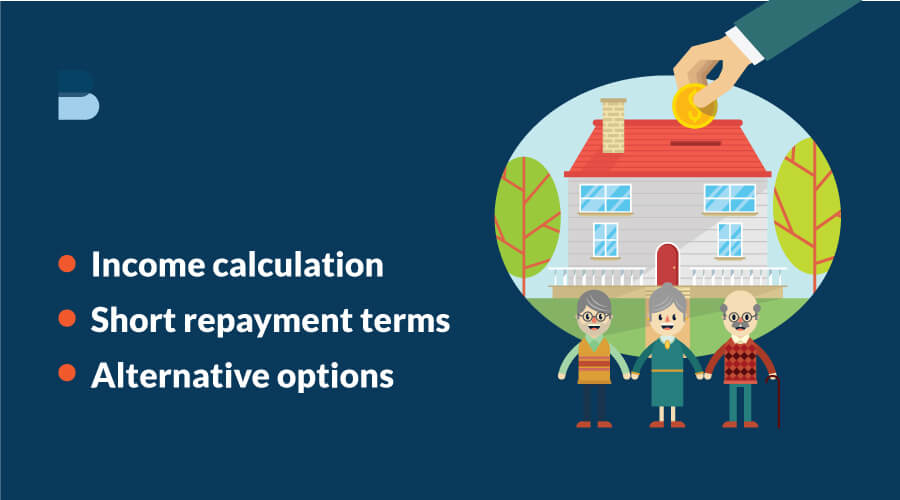
When trying to get a mortgage on this income, lenders often change how they calculate what you can borrow, and how you pay it back:
- Income calculation - Lenders need to see a sustainable income to which they can apply a multiplier. In terms of retirement income, your state and defined benefit pensions are usually regarded as sustainable income in the same way a salary would be. On top of this, pension pots will often be split down to a ‘notional income’, accounting for how much you can safely draw from the pot annually.
- Short repayment terms - Many lenders require a standard mortgage to end between the ages 70 - 80. The closer you already are to this age, the shorter your repayment term might be. This could lead to needing to repay the entire mortgage in just 10-15 years. This is what causes many pensioners to fail affordability checks (and why we’d suggest looking at other options).
- Alternative options - If you’re unable to pass usual affordability checks, this is where we’d normally begin to look at your alternative options.
Working out your retirement income when seeking a mortgage
When applying for a mortgage later in life, working out your ‘retirement income’ is a crucial step. This is how we’d suggest calculating your retirement income for a mortgage:
- Identify all sources of income
- Calculate projected income
- Provide documented evidence of all income sources
From here, a lender/broker will likely further investigate your financial situation to determine the best course of action for you.
Proving your income to a lender when retired
Proving your income to a lender as a retiree includes collating the correct documents to evidence consistent income. This usually comes in the form of:
- State pension statements
- Annuity income
- Bank statements showing regular deposits
- Private/workplace pension statements
What do lenders consider when pensioners apply for a mortgage?
When pensioners apply for a mortgage, lenders consider affordability against verifiable income sources. They’ll assess your retirement income, including stable payments into your bank, as well as other sources of income which might be able to supplement repayments.
They’ll also consider your age, potentially recommending specific mortgage products for older individuals.
Types of mortgages available to pensioners/older people

Individuals living from a pension still have a number of mortgage options available. These generally include tailored products such as retirement interest only mortgages, and lifetime mortgages (or equity release). These options usually require repayment when you move into care or die:
Retirement interest only mortgages - A product designed for over 55s, this mortgage type has no fixed end-date, and the loan is repaid fully upon death, moving into long term care, or selling the property. Only interest, but not upfront capital, need to be proven affordable.
Lifetime mortgages/equity release - Again for 55s and older, lifetime mortgages allow borrowing against home equity with interest being compounded and added to the loan rather than paid monthly, repaid when you move into care or pass away.
Standard repayment mortgages - Some mortgages have increased maximum age limits, even up to 70 - 80+. For this mortgage type, there must be a clear sustainable repayment plan.
Joint borrow sole proprietor - Allows a younger, working family member onto the loan to support payments.
How to get a mortgage as a pensioner
To get a mortgage as a pensioner, you need to begin by educating yourself on the available options, as well as understanding your financial situation. This allows you to determine whether it’s actually financially viable for you to take on the mortgage that you are hoping to, and the best way to do so.
Further to this, you need to gather the documentation which evidences your consistent income, so that you can prove to potential lenders that you actually have the capital to go ahead with a purchase.
Usually, the best way to do this is by working alongside an expert financial advisor, such as our team at Barlow Irvin, to discuss your personal financial situation, and work out the best way forward.
Can you use pension funds for a house deposit?
From the age of 55 (58 from 2028 onwards), you can usually use funds from a private or workplace pension for a house deposit. However, taking out a large sum (over 25%) could trigger tax implications by pushing you into a higher tax bracket.
Get in touch with Barlow Irvin for pension-specific mortgage information.