


When many people hear the word ‘mortgage’, they automatically think of traditional terraced, semi-detached or detached houses. However, mortgages also apply to other residential property types, such as flats and apartments.
Learn more about the different types of mortgages you can get on a flat, and how to get mortgages on varying kinds of flats and apartments.
Is it harder to get a mortgage on a flat?
Getting a mortgage on a flat can be more difficult than on a house. Affordability checks and credit checks are generally similar to standard house mortgages, but you may run into more issues because lenders view flats or apartments as ‘higher risk’ as they are harder to resell.
You may face higher deposit requirements and less options as a result.
Types of mortgages you can get for a flat

There are still a number of mortgage types you can get for a flat. These include a range of standard and specialist products:
- Capital and interest - Monthly payments cover repayments for loan and interest. In the end, you will own the flat outright.
- Interest only - You only pay interest to the lender each month, so monthly payments are lower. You need to prove that you have an investment or savings plan to pay off the lump sum at the end of the term.
- Fixed-rate - An interest rate is locked for a fixed period of time (usually 2, 3 or 5 years), with monthly payments staying the same throughout this period.
- Tracker - Tracker mortgages follow the bank of England base interest rate. Monthly payments will change monthly to reflect this.
- Discount rate - You’ll get a set discount from the lender’s standard variable rate (SVR) for a set period of time.
- Shared ownership - A scheme under which you buy a share of the flat, then pay reduced rent to a housing association on the remaining share. You can then get a mortgage to cover the value of your share.
- Buy-to-let - Suitable if you’re looking to buy a flat as an investment as opposed to as a primary residence. The amount you can borrow is usually based on predicted rental income rather than salary.
- First time buyer - Many first time buyer products offer higher loan to value ratios (lower deposits).
How the type of flat you’re buying affects mortgage options
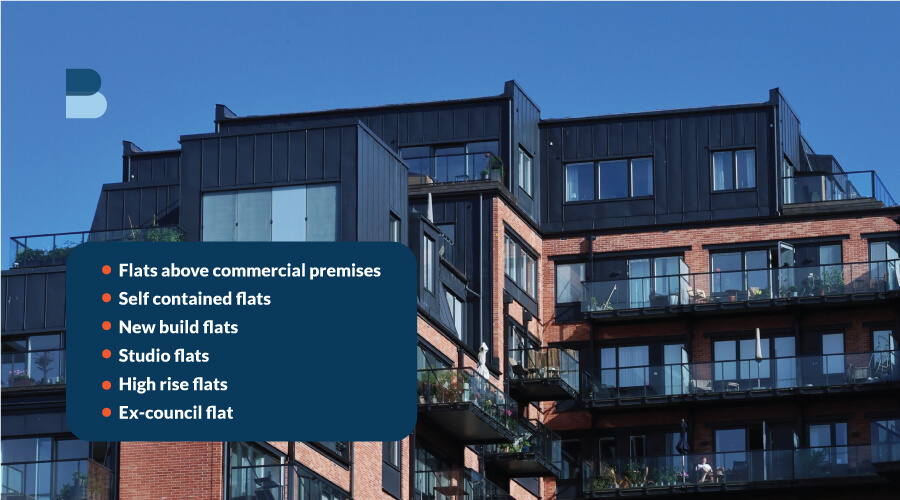
Your mortgage options can be impacted by the type of flat you’re looking at buying. Flats in different locations and layouts can be regarded very differently by lenders, so it’s important to have an upfront understanding of which type you’re going for.
Flats above commercial premises
Lenders can be cautious about flats above shops, restaurants and takeaways because of the resale risk caused by noise and odour. Many will require lower-risk premises and cap the loan-to-value ratio.
Self contained flats
Self contained flats are usually the most straightforward to mortgage because they’re the easiest to resell.
New build flats
New builds often come with lower maximum loan-to-values (often 85%), as lenders factor in the possibility of the property losing value over time. There are usually a range of developer incentives which affect how much a lender is willing to lend.
Studio flats
Smaller studios can be difficult, as lenders often stipulate minimum square footage requirements. This may mean your mortgage options are limited to specialist types.
High rise flats
Especially following the fallout of the Grenfell disaster, high-rise flats face additional scrutiny. Cladding certificates and fire safety assessments can limit options until work is complete.
Ex-council flat
Many lenders will mortgage former local authority flats, but some have restrictions, particularly on high rise ex-council blocks or those with a high proportion of council tenants remaining in the building. As a result, deposit requirements may be higher across all mortgage types.
How freehold vs leasehold flats affect your mortgage
How you own a flat can significantly impact your mortgage options. Most UK flats are leasehold, meaning you own the property for a fixed term. Lenders typically require at least 85 years remaining on the lease when you apply. Once it drops below 80 years, extending becomes more expensive due to ‘marriage value’, and some lenders will decline altogether.
- Most lenders also want the lease to extend at least 30 years beyond your mortgage term.
Freehold flats, while seemingly more attractive, can actually cause more problems. Without a shared management structure, there's no legal mechanism to enforce building maintenance or compel other flat owners to contribute to repairs. As a result, many lenders are unwilling to lend on them at all.
For leasehold properties, lenders also scrutinise ground rent terms. Escalating ground rent clauses can make a flat unmortgage-able with many mainstream lenders, so always review the lease carefully before applying.
Getting a mortgage on a flat or apartment
Getting a mortgage on a flat or apartment can be difficult, so it’s usually best to seek support from a specialist mortgage advisor upfront. With our help, you’ll have access to the whole of the market, including a range of specialist brokers offering more bespoke products which will suit your needs.
We’ll advise as to the most financially beneficial or viable route to securing a mortgage on a flat or apartment, and manage the process every step of the way. Get in touch with Barlow Irvin today for more information.