

As a homeowner, or somebody looking to buy their first home, it’s very important to understand all of the different factors which may play into interest rates and base rates.
Aspects of world politics such as geopolitical conflict, inflation, swap rates, international policy, economic stability and many more can all have a significant impact on UK mortgages.
Why global politics and conflicts affect UK mortgage rates
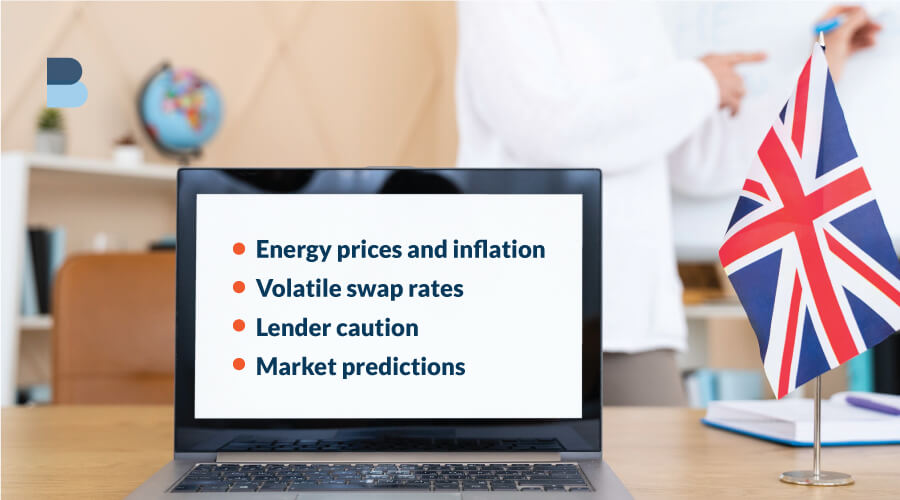
Global politics and conflicts affect UK mortgage rates differently depending on the nature of each factor. Global tensions, such as the 2026 Middle East tensions, affect UK mortgages in the following ways:
Energy prices and inflation - Conflicts in regions which mine/produce high quantities of oil drive up global energy costs. This increases UK inflation, as we primarily import energy. In turn, it’s less likely that the Bank of England will cut base rates.
Volatile swap rates - Swap rates are interest rates which institutions use to exchange funding. Geopolitical uncertainty drives these rates up, resulting in immediate increases in fixed mortgages..
Lender caution - Lenders can become more cautious during times of high uncertainty. This decreases the number of available and affordable deals on the market.
Market predictions - Lenders make long term financial predictions. Current, or even potential political issues and conflicts can point to long term economic damage.
The overall impact of world politics on new and existing homeowners
Overall, the state of world politics has a direct impact on both new and existing homeowners.
For new or prospective homeowners, affordability decreases and new-build products become rarer.
For existing homeowners, global political uncertainty often impacts property value, though it’s impossible to say for definite whether values go up or down.
What analysts are predicting will happen to the UK mortgage market
The Middle East conflict has damaged initial 2026 forecasts for rapid mortgage rate cuts. Surging oil prices pushed inflation toward 3.3%, forcing analysts to scrap forecasts for a 3.25% base rate. Instead, the Bank of England may hold or even hike rates to 4.5% to offset energy shocks.
Consequently, average 2-year fixed rates have climbed toward 5.8%, stalling discretionary buyer demand. Currently, the market has shifted from recovery into a cautious mode. Until geopolitical tensions ease and energy prices stabilize, mortgage costs will likely remain elevated, keeping house price growth stagnant.
What history tells us about world politics, conflicts and mortgages
History shows us that as a serious conflict breaks out, mortgages are almost immediately impacted in one way or another.
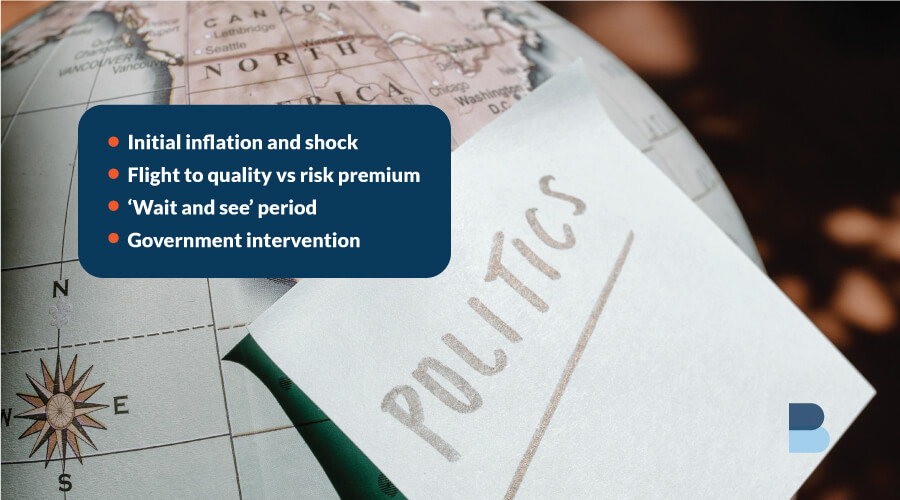
On top of this, there is a typical consistent pattern which relationships between mortgages and world politics/conflicts follow:
Initial inflation and shock - Historically, energy is the main link between conflict and mortgages. A good example is the ‘Yom Kippur War’ in 1973, which led to an oil crisis. In turn, rates jumped from 8% - 13% in a matter of months, rising even further as time progressed.
Flight to quality vs risk premium - When world politics and circumstances get volatile, investors begin to move their money. Mortgage rates can be temporarily lowered, though it's typical that long term economic instability causes lenders to become nervous about people’s ability to repay loans. In turn, they may add a ‘risk premium’ to products.
‘Wait and see’ period - During periods of political uncertainty, such as during Brexit negotiations and the build up to the Iraq war (2003), transaction volumes dropped significantly.
Government intervention - During long-term political conflicts or unsettlement, governments may step in to protect the housing market and national economy. We saw mortgage holidays and stamp duty cuts during the Covid-19 pandemic, suggesting that modern governments may consider mortgage support schemes.
Why it’s important to speak to a mortgage broker
Speaking to a mortgage broker is especially important during times of economic uncertainty because we can help you to navigate rapidly shifting interest rates and the changing criteria of lenders.
In a volatile market, seeking expert financial advice is the number one way to ensure that you secure the best possible deal, and avoid costly financial errors whilst things are unsettled.